






Environmental Statement
EMAS STATEMENT REPORTING PLATFORM

Environmental Statement
EMAS EUROPEAN REGULATIONS

Environmental Statement
EMAS STATEMENT REPORTING PLATFORM
PORLAND VALDERRIVAS CEMENT GROUP: VALLCARCA QUARRY
 |
General data |
Introductory Presentation
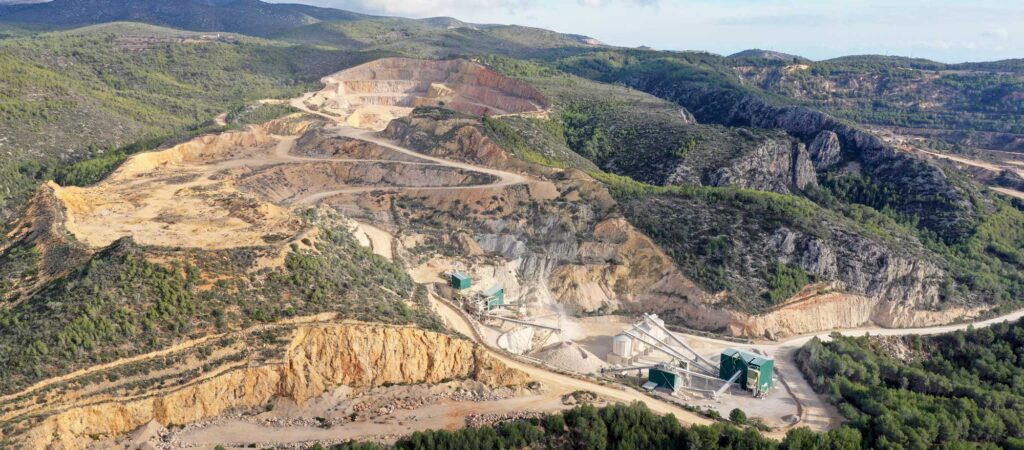
This link contains our sixteenth Environmental Statementfor the Vallcarca quarry owned by Cementos Portland Valderrivas, in accordance with EMAS regulations. It is the first statement that we have published in a 100% online and digital formatfor our stakeholders and interested parties.
The Grupo Cementos Portland Valderrivas in the business of manufacturing basic construction products. Its main activity is cement manufacturing, but it also has plants for manufacturing aggregates, mortar, and concrete. These products are manufactured based on a commitment to sustainable development and in a manner compatible with climate protection and the principles of responsibility, applying a life cycle approach (from the supply of raw materials to the end of the product's useful life).
OurEnvironmental Management System (based on ISO 14001:2015)incorporates risk and opportunity management, with a life cycle approach that includes planning, control of environmental aspects, compliance with requirements, and improvement plans. Indicators and results are prioritized, summarizing environmental progress compared to previous statements to highlight improvements. All the content of the Environmental Statement has been reviewed by Management, with independent validation byAENOR (the certificate can be seen at the end of the document). All Statements are available on our website www.valderrivas.es, or can be requested from us through the various channels listed on the last page of this statement.
Agenda 2030. Related Sustainable Development Goals
This Environmental Statement includes at the end a specific section with information on the 2030 Agenda.




 |
2024 |
 Centre/s
1
 Workers
6
 Surface area
2,022,900 m2
 Activity in
Tons of blasted rock and tons of aggregate produced
Total product manufactured: 654,590 tons.
Ref. Unit: Manufactured product (aggregate produced + reject)
Our organisation presents this validated Environmental Statement as part of our commitment to transparency and environmental improvement of our activities, operations and facilities.
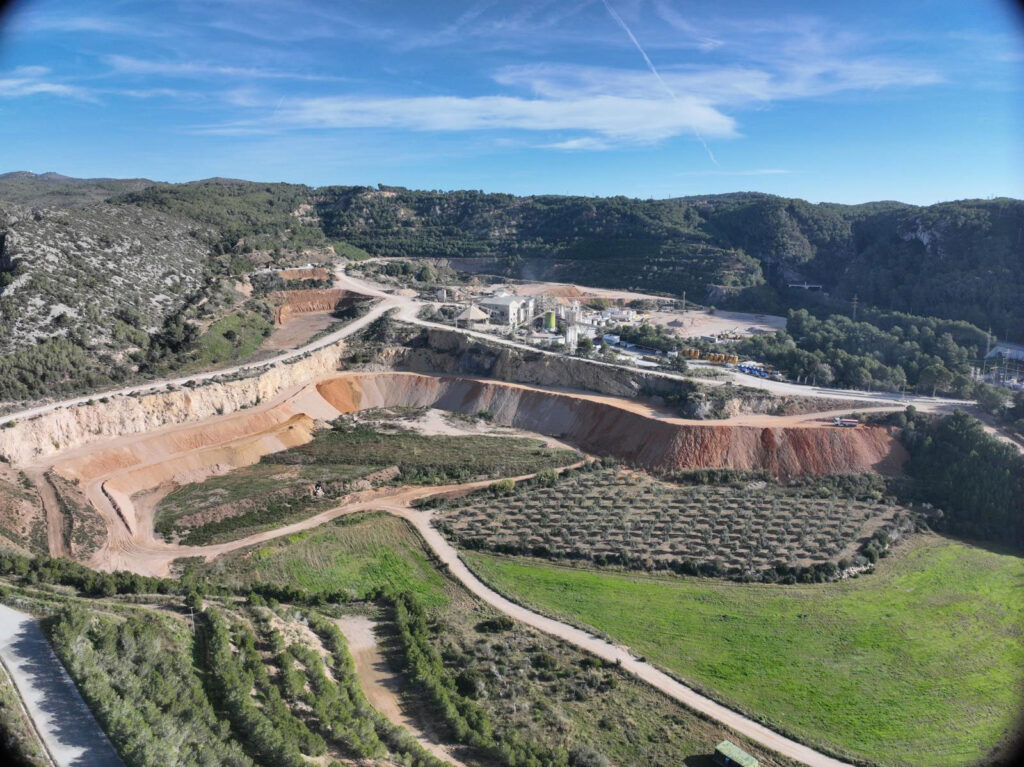
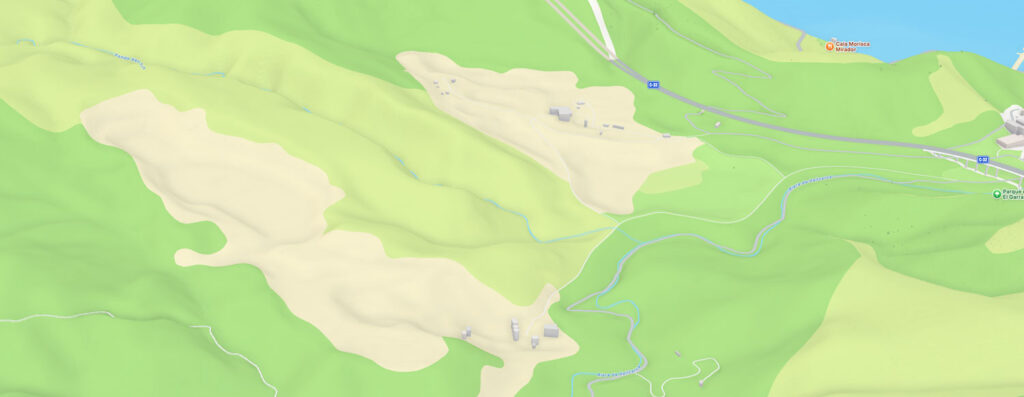
LOCATION- MAIN CENTER
Our organisation presents this validated Environmental Statement as part of our commitment to transparency and environmental improvement of our activities, operations and facilities.

Social information
Link here to our main social networks.
 |
 |
 |
 |
Environmental assessment and performance |
|
Key metrics |
◉ Global indicators 2024
Includes the sum of all the organisation's sites under the EMAS Register.
ENERGY CONSUMPTION

2,853.80MWh
• Renewable energy consumption 4.7%
• Renewable generation0%
WATER CONSUMPTION

9,357m³
• Supply network0%
Source Well
SANITARY DISCHARGES

66.95m³
- Public waterway 0
- Sewage system 0
CO2 EMISSIONS

1,327.578tons
• Indirect98.19%
• Direct1.81%
WASTE

10,518tons
• Hazardous 2.83%
• Recovery 69.77%
Unit values on production/performance
0.006 MWh/Tn Blasted rock and Tn of aggregate produced
0.014 m³/Tn Blasted rock and Tn of aggregate produced
0.0001 m³/Tn Blasted rock and Tn of aggregate produced
0.002 Tn/Tn Blasted rock and Tn of aggregate produced
0.000016 Tn/Tn Blasted rock and Tn of aggregate produced
Unit: Tons of blasted rock and tons of aggregate producedManufactured product (aggregate produced + waste)
|
Dimension of the activity |
Evolution of production activity
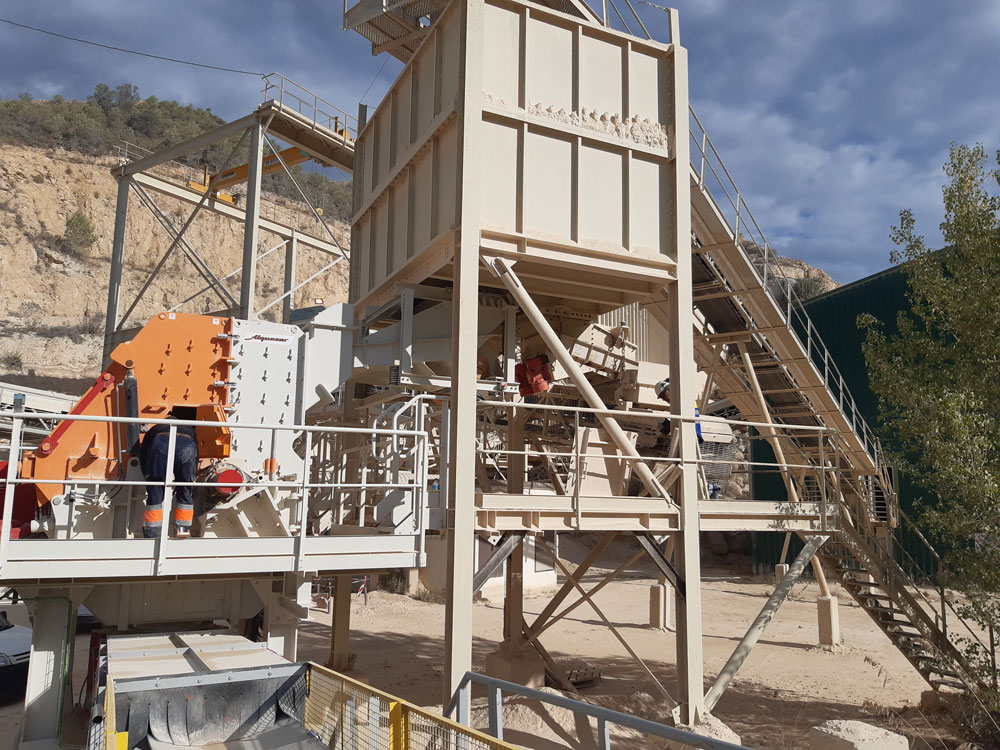
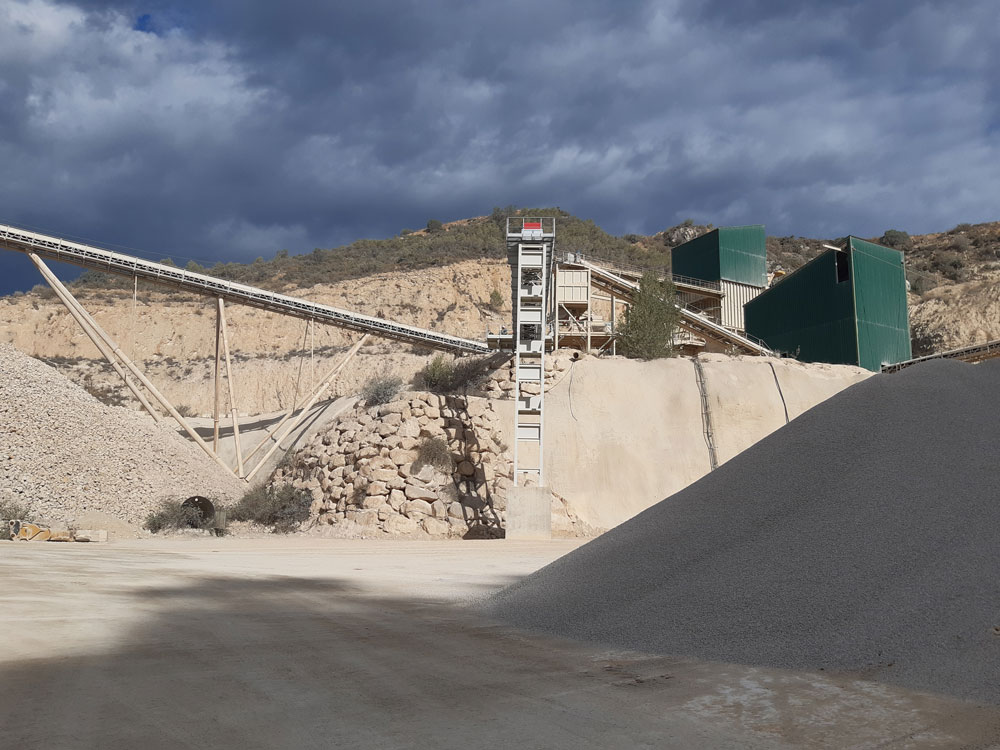
In 2024, 756,565 tons of limestone were extracted and 513,010 tons of aggregate were produced at the Vallcarca plant. All the blasted rock was basically used to manufacture aggregates, and the variations observed in production compared to previous years are due to market demands. Aggregates are mineral, solid, and inert materials with suitable particle sizes and characteristics in accordance with regulatory specifications. They are the main suppliers of raw materials for infrastructure construction, building, industry, and environmental protection, making aggregate production a strategic industry. The variety of products manufactured at the Vallcarca plant are mainly used in the manufacture of concrete and mortar, as riprap, and a small portion is reused in the manufacture of cement. The final product is mainly distributed in the domestic market. All aggregates have CE marking, which means that all products marketed comply with the requirements of the Construction Products Directive.
 |
Energy use and management |
Environmental management and control
Electricity consumption
The increase in the ratio in 2024 is related to the production of finer aggregates that require more grinding time. This year, production of AF-T-0/2-C fine aggregate has increased at the Locotrack plant due to market demand.
Fuel consumption
The above data shows an increase in the diesel consumption ratio of quarry vehicles, shovels, and trucks that transport limestone from the quarry faces to the processing plants. This consumption varies depending on the location of the quarry faces.
And the diesel fuel consumed by vehicles and aggregate production facilities has remained similar to previous years.
Evolution of specific metrics and ratios
Units of energy consumption in MWh and their ratios associated with the activity.
|
Renewable energies |
...
Note: CNMC labeling of Fortia company 4.7% renewable energy.
 |
Water use and management |
Environmental management and control
In 2024, Decree-Law 9/2023 on extraordinary and urgent measures to address the drought situation in Catalonia remained in force. The data in the table reflect the positive impact of the measures taken at Vallcarca to reduce water consumption by optimizing irrigation in restored areas and, as specified in this Decree-Law, eliminating the use of water for irrigation of roads.
Evolution of specific metrics and ratios
 |
Waste water discharge management |
Environmental management and control
Public waterway receiving the discharge: Watertight septic tank.
 |
Atmospheric emissions |

Environmental management and control
At the Vallcarca aggregates plant, six main sources of particle emissions from chimneys have been identified. These sources are associated with the processes of feeding hoppers, grinding, and shipping the final product. These emission sources are equipped with bag filter-based purification systems, which are the Best Available Techniques in the sector and purify dusty air currents before they are released into the outside environment. The operational efficiency of the filters is checked periodically following a predictive maintenance plan or through spot checks of particle emissions. Spot checks are carried out according to the frequencies established in the Environmental Authorization, every 2 or 3 years depending on the facility. The last checks on these filters were carried out in 2023, and the results were within the limits established in the Environmental Authorization. In 2024, the checks established in the predictive maintenance plan were carried out to ensure that they were working properly. The main sources of diffuse dust emissions into the atmosphere are due to the transfer and movement of powdery materials in aggregate manufacturing facilities and also to the circulation of trucks on the dirt roads of the quarry. Diffuse emissions are minimized by adopting a series of preventive measures such as: Continuous monitoring of the facilities allows us to act immediately if abnormal diffuse dust emissions are detected in the work areas. In addition, every three years, as specified in the quarry's emissions permit, a quantitative assessment of diffuse emissions is carried out through the control of sedimentable particles by an accredited control entity. The last check was carried out in the spring of 2022, and the results for total suspended particles at the three points evaluated were below 300 mg/m³.2 day, the reference value set in the technical instruction of the Directorate General for Environmental Quality for the control of diffuse emissions. It should be noted that these specific checks are influenced by working conditions, but also by the weather conditions during the period in which they are carried out and the distance between the location of the control points and the work area.Emissions from channeled sources
Diffuse source emissions
 |
CO2 emissions |
 |
Waste production and management |
Environmental management and control
The Vallcarca aggregate production plant is registered in the Industrial Waste Producers Register under code P-65566.4, and in March 2025, the Annual Waste Producers Declaration was submitted (Waste Law 22/2011).
The production of aggregates and the extraction of limestone generate a minimal amount of waste, most of which is Hazardous. Annual variations are primarily due to specific maintenance work and facility cleaning operations.
Since the production of Hazardous waste Hazardous exceed 10 tons per year, it is not necessary to submit a Hazardous Waste Minimization Plan.
Evolution of specific metrics and ratios
 |
Management of raw materials and resources |
Environmental management and control
The amount of explosive used depends mainly on the geological characteristics of the mining fronts, and the blasting area is always studied in advance in order to optimize the consumption of this material, which is why similar ratios are maintained year after year.
As for the consumed stone, although the yield of the aggregate production process is very high, there is always some waste. Waste is the blasted stone that is not used in the manufacture of aggregates because it does not meet the specifications required to obtain the different products.
The above data shows a reduction in the rejection rate over the last year, indicating an improvement in the performance of the aggregate production process, possibly due to the quality of the quarried stone, optimization of the production process, or the characteristics of the manufactured products.
As a good environmental practice, this waste can be reused in the production of clinker and cement, in construction projects, or as fill in restored areas. In 2024, part of it was reused in the restoration of the quarry.
Evolution of specific metrics and ratios
 |
Biodiversity |
Biodiversity indicators
Quarry exploitation has a temporary impact on the landscape, and the Group has defined the "development of integrated management criteria for quarry restoration and biodiversity promotion" as a future challenge. This challenge is in line with the additional exploitation/restoration measures established in the Environmental Authorization for the activities carried out in the quarry. These additional measures also take into account the fact that the activity is included in the European Natura 2000 Network (XN2000), as it has been declared a Special Protection Area (SPA) due to the nesting of a pair of Bonelli's eagles (a priority species included in Directive 79/409). At the Vallcarca site, it is worth highlighting the restoration work begun in the old quarry square in 2008, based on the restoration project drawn up by Fundación Natura, which was subsequently expanded and approved by the competent authority in December 2010 as a restoration program for all mining activity. This project focuses on creating different habitats that promote biodiversity and benefit certain species of flora and fauna that may be vulnerable. To this end, the restoration project combines areas for growing herbaceous plants, scrubland plantations, Mediterranean meadows, pastureland plantations consisting of old, widely spaced trees, and depressed, waterproofed areas to encourage water accumulation. In January 2019, approval was received from the Administration for the new restoration program for the Vallcarca quarry and the resolution from the Directorate General of Mines informing of the incorporation of this restoration program into the Vallcarca No. 3,889 operation. MAIN RESTORATION WORK IN 2024 In 2024, restoration work continued in zones 32 and 33, shaping the slopes and the plaza. To promote biodiversity, a population of 100 pigeons has been preserved in the dovecote on front 8 during the eagle nesting season. In addition, the biologist hired by the company has continued with ornithological monitoring. During this period, work has also continued on the maintenance of areas previously restored through phytosanitary treatments on pine trees, pruning of pine and olive trees, cleaning of the drainage network, and sowing of cereals in the usual cultivation areas and in zone 30 (new sowing). Due to the entry into force of Decree-Law 9/2023 on extraordinary and urgent measures to address the drought situation in Catalonia, irrigation in these areas has been significantly reduced. MONITORING OF NESTING AND BEHAVIOR OF PROTECTED SPECIES
 |
Other information of environmental interest |

Significant and/or sector specific indicators
Sound emissions
The work carried out at the Vallcarca quarry, the aggregate production process itself, and the movement of heavy vehicles along the quarry roads are sources of noise in the surrounding area that affect the local population and wildlife.
The location of the quarry and the Vallcarca aggregate plant, isolated from the main neighboring towns and with favorable terrain, minimizes this impact on the population. In any case, every two years an official noise control is carried out at the Campdàssens farmhouse, the building closest to the quarry and which can be considered sensitive to noise. The last check, carried out in April 2024, showed that the limits established in Decree 176/2009 of November 10 were being complied with.
As for wildlife, the nesting of a pair of Bonelli's eagles in the quarry has led to the implementation of additional measures to reduce noise. These measures include enclosing the main aggregate production facilities and modifying the main route taken by vehicles in the quarry to avoid disturbing these birds during their nesting period.
Vibrations
The control of vibrations from blasting in the quarry is carried out in accordance with the criteria of standard UNE 22.381:93, which regulates vibrations produced by blasting. The peak vibration velocity limits established for Group II buildings (residential buildings) are considered to be the criteria for damage prevention.
For each blast, the percentage of approach to the limit is calculated, with a maximum value of 100%, using the records obtained from the seismograph located at the Metso plant facilities. In 2024, the average value recorded was 7.6%, and the year-on-year variations are mainly due to the characteristics of the blasted rock and the distance between the blasting area and the seismograph's location.
Soils
In November 2015, the baseline report on soil and groundwater for the entire Vallcarca site was submitted to the authorities: quarry, cement factory, and aggregate, mortar, and concrete plants.
The Environmental Authorization resolution of June 2017 establishes a series of preventive measures for the protection of subsoil and groundwater, such as: compliance with technical instructions regarding the storage of hydrocarbons and hazardous substances, establishment of a network of subsoil quality monitoring points in potential areas of concern, and the establishment of a maintenance and supervision plan for the measures adopted.
The latest groundwater monitoring checks in piezometers and wells, as well as checks on vapor collectors located in the factory and quarry areas defined in the environmental authorization, were carried out in 2022. All the points analyzed complied with the reference values or threshold values established by the Catalan Waste Agency.
|
Impact analysis and improvement planning |
 |
Environmental aspects and impacts |

Description of the most important and significant environmental aspects
Our activity takes into account the identification and assessment of the impact ofdirect environmental aspects, under normal and abnormal operating conditions, indirect aspects, and emergency aspects. Theformer are those generated as a result of activities in the quarry, over which there is full control of their management. Grouped according to their environmental vector, the environmental aspects under normal and abnormal conditions shown in the attached table have been identified and assessed. We also assessindirect environmental aspects arising from activities over which we do not have full control.
Specifically, the latter correspond to greenhouse gas emissions resulting from the transport and distribution of the final product and the fuels used, those associated with electricity consumption, and the management of aggregate waste at the end of its useful life. In 2024, no indirect environmental aspects have been identified as significant. In this way, environmental aspects have been linked to all stages of the aggregate production life cycle, from stone extraction to the end of the materials' life.
The evaluation of environmental aspects is a starting point for the revision of the System, and for the definition and updating of operational control and improvement planning procedures. This evaluation is carried out annually on the basis of a series of environmental criteria:
- Hazard or level of environmental impact of the aspect.
- Quantity or volume of the environmental aspect.
- Complaints received from stakeholders and legal non-compliance.
- Severity or level of severity of the impact, generally associated with the intrinsic and objective hazard.
- Probability, frequency or recurrence with which the aspect occurs.
- Capacity to influence economic, technical or human resources to carry out actions for prevention, control and correction of the aspect.
This Statement shows the so-called significant results, which are the outcome of objective analysis, applying our evaluation procedure in each case.
Description of significant environmental aspects
 |
Environmental improvement planning |

Environmental improvement planning
In 2023, a target was set to increase the restored area in the quarry in order to improve biodiversity in the surrounding area, a target to be developed in 2023-2024.
In December 2024, a ratio of restored area to affected area of 42% was achieved, meeting the indicator set in this objective.
 |
Legal compliance analysis |

List of permits, authorizations and declarations in force
LThe main references applicable to limestone and marl extraction activities and the manufacture of aggregates are as follows:
- Resolution, dated June 7, 2017, renewing the environmental authorization of the company Cementos Portland Valderrivas, S.A., for the manufacture of clinker and cement and the operation of aggregate, concrete, and mortar plants located at the Vallcarca plant (file no. B1RP140325).
- Resolution, dated October 27, 2017, of the appeal for reconsideration filed by the company against the resolution dated June 7, 2017.
- Resolution of non-substantial change, dated July 28, 2020, consisting of the modification of the table of waste produced, incorporating new waste codes without increasing the total amount of production (file ref. B1CNS200201).
- Resolution of January 29, 2013, granting a 30-year extension of the concession to operate the Vallcarca quarry.
- Resolution authorizing emissions from activities that could potentially pollute the atmosphere for the Cementos Portland Valderrivas facility—Vallcarca quarry (file no. BAAE170005 dated March 1, 2019).
- Favorable report from the Directorate General for Environmental Quality (DGQA) on the update of the CD Vallcarca Ampliación 01 mining restoration program. Received in January 2019.
- Resolution of the Directorate General for Energy, Mines, and Industrial Safety, incorporating the new activity restoration program into the Vallcarca operating concession no. 3889. Received in January 2019.
The Integrated Environmental Authorization is an authorization granted by the Government of Catalonia, which sets out the technical requirements and control regime to be followed for most of the environmental aspects identified in the activities carried out at the Vallcarca quarry.
And the Emissions Authorization for the quarry site, also granted by the Government of Catalonia, establishes measures for the prevention and control of air pollution caused by the activities carried out in the quarrying operations.
Specifically, for the activities carried out at the Vallcarca quarry, the following legal requirements have been identified for 2024:
- Authorization for the use of angle grinders and blowtorches in maintenance activities carried out in the quarry during the period from March 15 to October 15, 2024.
- Authorization for the burning of explosive containers during the period from March 15 to October 15, 2024.
Regulatory Compliance Summary
- The activities carried out by the Vallcarca quarry are conducted in accordance with current European, national, regional, and local environmental regulations, as well as the specific requirements of each facility. An annual assessment of environmental legal compliance is carried out with the participation of the company's legal advisor.
|
Good environmental management practices |
Ecodesign and life cycle analysis
Product Life Cycle Analysis
Life Cycle Assessment (LCA) of a product, process, or technology is a methodology that attempts to identify, quantify, and characterize the different aspects and potential environmental impacts associated with each stage of a product's life cycle. This analysis will provide valuable information that will enable the sector and users to make decisions aimed at improving environmental performance with regard to processes and products.
The life cycle associated with aggregate production has been developed, including all stages of the manufacturing process.
Although it is beyond the scope of this statement, it should be noted that specific environmental product self-declarations for the GCPV Group's cement plants and for each type of cement produced have been prepared using a tool validated by AENOR and were verified during 2024.
Best practices in environmental management
Best Environmental Management Practices
Integration with SDG of Agenda 2030


◉ Verification record
This Digital Environmental Statement has been verified by:
- AENOR
The most valid document, or in case of discrepancies, is the PDF digitally signed by the verifying body. This document is a true reflection and printout of this Digital Environmental Declaration or rendered web page. You can download this render here as the CURRENT ENVIRONMENTAL DECLARATION: GCPV VALLCARCA
Date of lastedit: – Master File Version No.: 0
ORGANIZATION: PORLAND VALDERRIVAS CEMENT GROUP – CENTER(S) – COVERAGE: VALLCARCA QUARRY
ACCESS TO THE EUROPEAN REGISTRY: EUROPEAN COMMISSION
TRANSLATIONS OF THIS ENVIRONMENTAL STATEMENT: This EMAS Environmental Statement has been verified in its original language. The browsers used by stakeholders for consultation, or the Platform RightSupply itself, may automatically translate its direct transcription, without the certifying body considering its translated content as validated a priori. Methods such as sworn translation are recommended for this purpose.
EXTERNAL LINKS AND AUDIOVISUAL CONTENT: This EMAS Environmental Statement has been verified in its entirety, with the exception of external links and audiovisual or videographic content that may have been included for complementary purposes.
DIGITALIZATION: Digitization of environmental statements is a best practice with multiple sustainability benefits. By eliminating the use of paper, a significant reduction in energy and water consumption is achieved, which in turn minimizes the carbon footprint. This digital transition not only supports the environment, but also improves data accuracy and consistency, optimizing management efficiency, environmental reporting and access to information for stakeholders. This initiative was recognized as a best practice in 2022 within the European Union's INTERREG EUROPE public policy program (ENHANCE EMAS), underlining its importance in promoting a greener and more efficient administration across Europe.
Template: 2026 Extended