
Environmental Statement
EMAS STATEMENT REPORTING PLATFORM

Environmental Statement
EMAS EUROPEAN REGULATIONS


Environmental Statement
EMAS STATEMENT REPORTING PLATFORM
COPCISA: COPCISA-Terrassa-Office and construction sites
PENDING VALIDATION
 |
General data |
Introductory Presentation
COPCISA, SA promotes and manages infrastructures that contribute to the improvement of the quality of life and the progress of people and society. The environmental protection of the environment in which we operate and the objectives of sustainability have always been in our principles of action.
At COPCISA, SA, we promote the constant and progressive improvement of our environmental performance, Search in all our activities. To this end, we enhance our processes and technical capabilities in a sustainable manner, applying widely recognized standards and guidelines. To achieve this, COPCISA, SA implemented and certified an environmental management system based on ISO 14001 in 2000, adapting it to the EMAS Regulation in 2022 and applying for registration.
The EMAS scope for COPCISA, SA is the headquarters in Terrassa (office) as well as the works in progress (civil works and building) for the year of verification.
In reference to the environmental policies of the COPCISA INDUSTRIAL group, it has ISO 14001 certification in the different companies; NOVANTIA, PABASA, ISTEM, INNOVIA and HORMICONSA. In addition, there are available for all of them the Inscriptions in the Carbon Footprint Registers (state and autonomous level) from 2018 to the present.
For the time being, there are no plans to extend the EMAS Registry to the rest of COPCISA, S.A.'s fixed sites or to the rest of the group's companies.
COPCISA, SA's sustainable growth is based on the optimization of resources, their efficiency and the minimization of possible negative environmental impacts. COPCISA, SA has strengthened its commitment to sustainable development by joining the United Nations Global Compact and establishing Sustainable Development GoalsSDG).
EMAS registration date: 10/04/2022.
This statement is the fifth edition (follow-up audit). The next statement will be published in the second half of 2026.
 |
2025 |
 Centre/s
 Workers
 Surface
699 m2
 Activity in
M€
Our organisation presents this validated Environmental Statement as part of our commitment to transparency and environmental improvement of our activities, operations and facilities.
LOCATION- MAIN CENTER


Social information
Link here to our main social networks.
 |
 |
Environmental assessment and performance |
|
Key metrics |
◉ Global indicators 2025
Includes the sum of all the organisation's sites under the EMAS Register.
ENERGY CONSUMPTION

622,09 MWh
- Renewable consumption 42.30
- Renewable generation 0
WATER CONSUMPTION

21.531 m3
- Supply network 52
Origin Network | Others
SANITARY DISCHARGES

0m3 of water discharged to natural watercourse m3
- Public waterway 0
- Sewage system 100
CO2 EMISSIONS

1.125,05 Tn
- Indirect 8.72 % Indirect 8.72 % Direct 91.28
- Direct 91.28 % Direct
WASTE

78.738,52 Tn
• Hazardous 0.3%
• Recovery 96.89%
Unit values on production/performance
4,35 MWh/M€
151 m3/M€
0,94 m3/M€
7,69 Tn/M€
551,51 Tn/M€
|
Dimension of the activity |
Evolution of production activity

 |
Energy use and management |
Environmental management and control
The energy consumed in the Organization, consumption of fossil fuels and electricity consumption, has undergone variations in recent years due to the type of works executed. These consumptions are directly proportional to the execution needs of the works, so changes may occur from one year to another. In this year, the consumption of diesel oil has increased, as well as the consumption of energy from renewable sources. It should be taken into account that in some specific cases there is no data available on electricity consumption due to the fact that the supply is managed directly by the promoter of the work, with no consumption records or monitoring of the consumption of the work in a segregated manner.
Evolution of specific metrics and ratios
Units of energy consumption in MWh and their ratios associated with the activity.
|
Renewable energies |
...
 |
Water use and management |
Environmental management and control
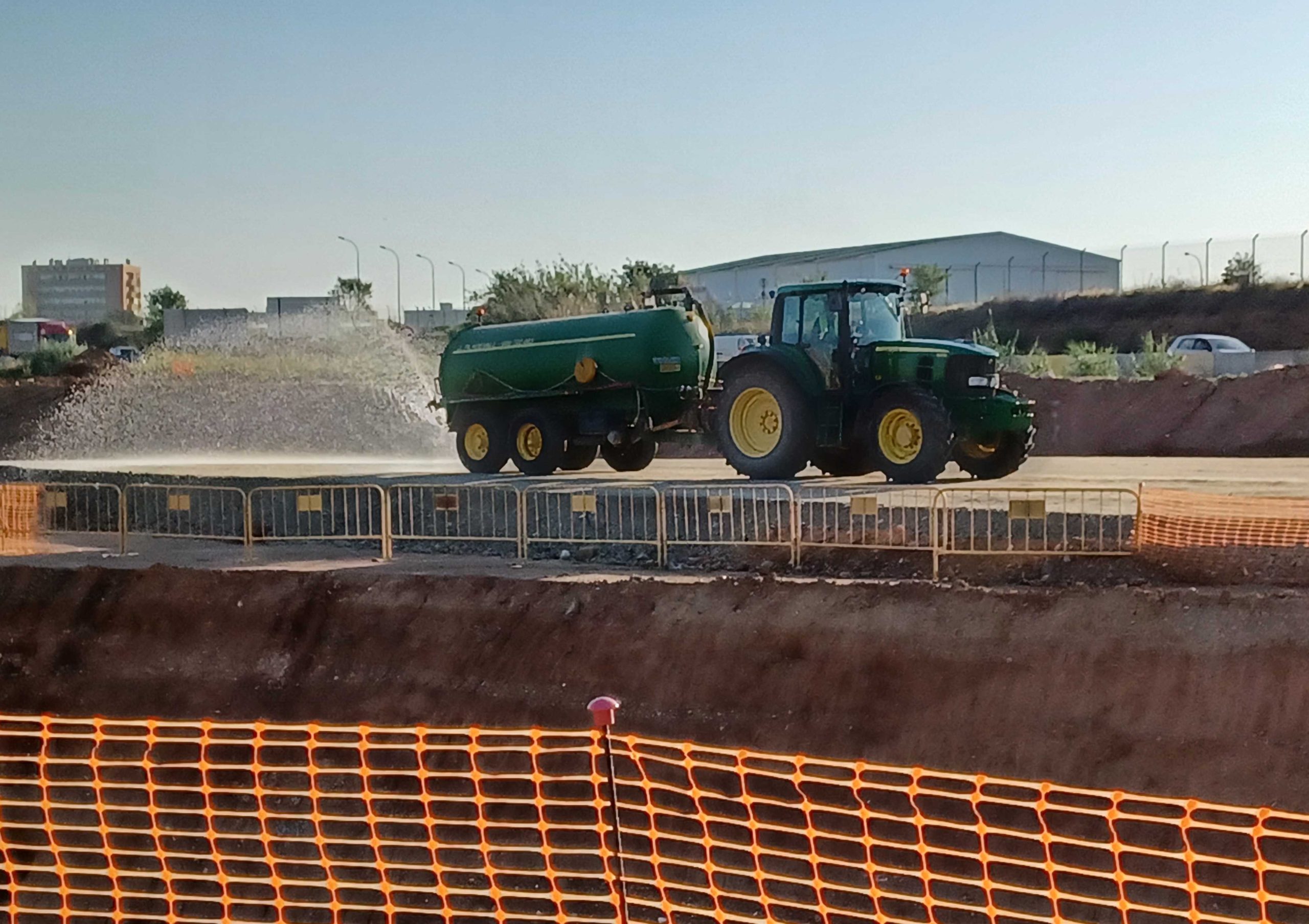
Whenever possible in the execution of the work, the Organization is committed to reusing water. For example, it is used in testing the watertightness of roofs, where water from upper roofs is used for lower ones. This is used for minor uses, irrigation, etc. There has also been a commitment to truck wheel cleaning systems with water recirculation for better use. In Catalonia, especially in the first half of 2024, due to the severe drought episode in the territory, the restrictions on irrigation have made it necessary to limit it only to essential uses, seeking as far as possible alternatives of lesser impact (for example, use of regenerated water from WWTP).
The origin of the water in most cases is from the supply network, although depending on the works they may have different origins, especially in civil works where water can sometimes be captured from the groundwater table or from existing ponds. It should be taken into account that in some specific cases there is no water consumption data available because the supply is managed directly by the developer of the work, without consumption records or monitoring of the consumption of the work in a segregated manner.
The source of the data in this section comes from the invoices for the different supplies.
Evolution of specific metrics and ratios
 |
Waste water discharge management |
Environmental management and control
In this year, due to the type of work carried out, no discharges to watercourses or infiltration to the phreatic level have been generated in the construction of the works.
Public watercourse receiving the discharge: Depending on the works and their location, there are different destinations of natural typology.
Evolution of specific metrics and ratios
 |
Atmospheric emissions |
Environmental management and control
The evolution ofCO2 emissions calculated in the Organization since 2020 has undergone variations, with a decreasing trend in the first years and a small increase in absolute value last year. In relative values, emissions in 2024 have decreased slightly compared to 2023. The emission factors used to estimate the Organization's carbon footprint are those published by the Ministry of Ecological Transition and Demographic Challenge of the version in force for the year declared. The data regarding the consumption of each energy source of the Organization come from the invoices of the contracted suppliers. Emissions in tons ofCO2 equivalent include aggregate emissions of CH4, N2O,CO2 plus indirect emissions derived from purchased energy. With respect to emissions of fluorinated greenhouse gases, no fugitive emissions of fluorinated gases from air conditioning equipment have been recorded in the reported period. As for PM (suspended particulate matter) emissions, quantitative data are not available since no measurements are taken. This significant environmental aspect is minimized with qualitative measures such as periodic watering during the earthmoving phases, wheel cleaning areas at machinery exits, and the obligation to place tarpaulins on trucks transporting earth or aggregates. During the demolition phases, watering is carried out and screens are provided to prevent the dispersion of dust in the buildings. Emissions of CO, NOx, SO2 and PST have been estimated from the emission factors published by the COIB-Balearic Government. It should be noted that there are no specific emission factors for gasoline combustion in stationary engines, so gasoline consumption for generator sets has been estimated with the emission factors for road transport. A density of 750 kg/m3 has been considered for gasoline and 840 kg/m2 for diesel, values within the ranges established in the current regulations (RD 61/20016).
 |
CO2 emissions |
GHG emissions certifications andCO2 registries
Con la clara convicción en trabajar por la reducción de sus emisiones, COPCISA SA se inscribe en el Programa de Acuerdos Voluntarios de la Generalitat de Cataluña desde el año 2019 y dispone del sello CALCULO del Ministerio de transición ecológica y reto demográfico verificado desde el año 2020. Con este compromiso en el cálculo y la reducción de las emisiones a la atmósfera, se ha elaborado una hoja de ruta para llegar a la neutralidad de carbono y se marcan objetivos anuales para minimizarlas. Las acciones más destacadas para la reducción de las emisiones consistirán en realizar un Plan de Movilidad de la empresa, sustituir los vehículos actuales por vehículos con energías más limpias, en un plazo de 10 años, apostar por la contratación de compañías eléctricas que utilizan energías renovables, disponer de casetas en las obras con placas solares y contratar a proveedores de proximidad (<50km) así como empresas que dispongan de un compromiso con la reducción de emisiones o dispongan de sistemas de gestión ambiental. En el caso del polvo se incorporan en las distintas obras sistemas de minimización del mismo, que pueden ir des de la pavimentación de los accesorios, la cubrición con lonas de los camiones, limitación de la velocidad en la obra, riegos periódicos, sistemas de retención de polvo en las demoliciones, etc.
 |
Waste production and management |
Environmental management and control
When it comes to managing construction waste, COPCISA, SA is committed to minimizing waste, properly sorting it at the source, and prioritizing recycling and Recovery .
All waste generated at construction sites is properly managed and covered by a Waste Management Plan(in accordance with Royal Decree 105/08 of February 1, which regulates the production and management of construction and demolition waste). Each site has a designated collection point for Hazardous waste Hazardous a separate area for Hazardous waste. The recycling station designed for the construction sites is reusable, properly labeled, and meets all regulatory requirements. Hazardous waste is stored in containers labeled according to each type of waste to facilitate proper on-site segregation. Recovery is always prioritized over landfill disposal, including the management of clean excavated soil, where its reuse in other construction projects or backfilling operations is promoted in accordance with the procedure set forth inOrder APM 1007/2017 of October 10, regarding general rules for Recovery excavated natural materials for use in backfilling operations and construction projects other than those in which they are generated.
With regard to waste management outcomes, in 2024, 96.89% of waste (including soil) was recycled and recovered, representing a 3% decrease compared to 2023. As for waste sent to landfills, the volume was also similar to the previous year (a 3% variation). Recovery excluding soil (which accounts for a high percentage of the waste generated), increased to 99.39%. This figure is very similar to that of the previous year.
The main wastes generated at construction sites are: soil, mixed stone waste, mixed construction site waste, concrete, wood, bituminous mixtures.
Regarding the breakdown of waste generated in 2024, the largest category is clean soil, followed by Hazardous waste, Hazardous to a lesser extent, Hazardous waste. In percentage terms, this would be 65.32% clean soil, 34.65% Hazardous waste Hazardous 0.03% Hazardous waste. This year, the amount of soil managed was the most generated waste, but it has decreased significantly compared to 2023; this is partly due to the type of construction projects, which influences the different percentages year after year.
The source of the waste data comes from the documentation provided by the waste managers. These managers provide us with the tracking and traceability documentation for each waste.
The conversion factor used for soils is 1.45 Tn/m3.
Evolution of specific metrics and ratios
 |
Management of raw materials and resources |
Environmental management and control
It should be noted that the consumption of raw materials varies greatly depending on the type of works contracted, as it directly influences their consumption. Even so, as indicated above, the use of recycled materials is promoted whenever feasible, such as recycled aggregates or iron/steel, mainly. Whenever possible, recycled materials or materials with an environmental eco-label are used.
Evolution of specific metrics and ratios
 |
Biodiversity |
Biodiversity indicators
The total land occupation of the activity in 2024 was a total of 1,626,830.43 m2 , of which 699 m2 are for the offices of the stable center and 546,569 m2 correspond to the area sealed in the different works. This area is considered sealed as it is the area occupied by the buildings or paved areas. Regarding the unsealed or nature-oriented surface, the total is 1,080,261.42 m2. This area corresponds to green surfaces, i.e. they are not paved and have the function of green areas in the works.
 |
Other information of environmental interest |
Significant and/or sector specific indicators
|
Impact analysis and improvement planning |
 |
Environmental aspects and impacts |

Description of the most important and significant environmental aspects
Significant aspects are identified through procedure P-CORP20B. This procedure identifies the significant direct and indirect environmental aspects of the centers or works. In the case of direct aspects, they are evaluated according to two general criteria; magnitude and severity. In the case of the evaluation of indirect aspects, they are evaluated according to the criteria of probability and severity (taking into account the parameters environmental impact, interested parties, purchasing requirements). A system of control measures is implemented to control these aspects through inspection points. Direct aspects are considered significant when the result of the weighting is equal to or higher than 6 points. In the case of indirect aspects, they are considered significant when the result of the weighting is higher than 40 points.
From these identifications, the most significant environmental aspects that have arisen in the works are as follows:
- Diesel fuel consumption
- Concrete consumption
- Water consumption
- Affecting the population
- Dust emissions generated by the circulation of vehicles within the construction site, excavation, paving and handling of materials.
- Emission of gases: From combustion of machinery, vehicles and equipment.
- Electricity consumption
- Noise and vibration
- Soil contamination; Leaks of oil, fuel, and other Hazardous chemicals.
The most significant identified, but not significant, were: Affectation to the soil by storage of chemical products, Consumption of geological resources, consumption of paper, Affectation to flora, Consumption of agglomerate/ bitumen and waste.
In the case of the Terrassa CTE, it has been detected as a significant aspect of waste (cardboard and paper).
And the aspects identified as not significant were: Water consumption, Electricity consumption, Paper consumption, Waste generation, Gas generation and Storage of chemical products.
To minimize these significant impacts, measures are being implemented to reduce their impact, and goals are also being incorporated to improve the Recovery waste generated at construction sites. In addition, efforts continue to monitor fuel consumption and minimize it whenever possible.
In the case of CTE, training is provided to reduce paper, electricity and water consumption.
Description of significant environmental aspects
The organization stands out for its environmental performance, which is continuously monitored and evolving. Each construction site has a technician trained to develop and implement the environmental management system properly. In addition, the Environmental Management Department provides support on the basis of periodic visits to the works, training, etc. The same Department is in charge of the evolution of the management system so that it can be improved year after year.
 |
Environmental improvement planning |
Environmental improvement planning
With respect to the evolution of last year's objectives, the objectives that have been met have been:
- Reduction of the carbon footprint has been reduced by 38.61%.
- 100% digital signature for all contracts
Regarding the objectives that will continue to be worked on because they have not been fully met:
- The use of LED luminaires in the CTE should be 100% and 95.62% has been achieved.
- Recovery company's overall waste Recovery was supposed to be 97%, but it actually reached 93.19%.
- Environmental training has not reached 70%; it has been 47.42%.
 |
Legal compliance analysis |
List of permits, authorizations and declarations in force
COPCISA, S.A. declares that all activities are carried out in compliance with the applicable environmental regulations, as well as the requirements voluntarily subscribed. In this sense, the Organization has not been subject to any environmental sanction.
The main permissions required by the Organisation are shown below:
- Communication of beginning of activity presented to the City Council of Terrassa.
- Activity license (according to procedure) for construction site offices (rented premises near the construction site. For example, Residencia Calle Mallorca, Vilanova y la Geltrú housing, Sirani housing in Terrassa, Baixada de la Gloria construction site in Barcelona).
Depending on the characteristics of each project, different permits are required, the most common of which are as follows:
- Permission to occupy the pavement for different works.
- Emptying permit.
- Permit to discharge to sewer when there is a temporary connection.
- Logging permit.
- Burning permit.
- Environmental communication of the construction site offices that require it.
- Have the Waste Producer code for each site and centre.
- Have the Annual Waste Report on hand when required (if more than 10 tons of Hazardous waste are generated Hazardous a facility with its own producer code).
Regulatory Compliance Summary
Among the numerous applicable laws, the main rules to be applied are the following:
- Law 18/2020 of 28-12-2020 on the facilitation of economic activity. DOGC.NO. 8307.31-12-2020
- Law 5/2013, of 11-06-2013, amending Law 16/2002, of 01-07-2002, on integrated pollution prevention and control and Law 22/2011, of 28-07-2011, on waste and contaminated soils. BOE.Nº 140.12-06-2013
- Royal Decree 553/2020, of 02-06-2020, which regulates the shipment of waste within the territory of the State. BOE.Nº 171.19-06-2020
- Royal Decree 108/1991, 01-02-1991, on the prevention and reduction of environmental pollution caused by asbestos. BOE.Nº 32.06-02-1991.
- Royal Decree 56/2016, of 12-03-2016, transposing Directive 2012/27/EU of the European Parliament and of the Council, of 25-10-2012, on energy efficiency, with regard to energy audits, accreditation of service providers and energy auditors and promotion of energy supply efficiency. BOE.Nº 38.13-02-2016
- Royal Decree 1367/2007, of 19-10-2007, which implements Law 37/2003, of 17-11-2003, on Noise, with regard to acoustic zoning, quality objectives and acoustic emissions. BOE.Nº 254.23-10-2007
- Royal Decree 1038/2012, of 06-07-2012, which amends Royal Decree 1367/2007, of 19-10-2007, which develops Law 37/2003, of 17-11-2003, on noise, with regard to acoustic zoning, quality objectives and acoustic emissions. BOE.Nº 178.26-07-2012
- Law 16/2002 of 28-06-2002 on protection against noise pollution. DOGC.Nº 3675.11-07-2002
- Decree 176/2009, of 10-11-2009, approving the Regulation of Law 16/2002, of 28-06-2002, on protection against noise pollution, and adapting its annexes. DOGC.Nº 5506.16-11-2009
- Royal Decree 1427/1997, of 15-09-1997, approving the Complementary Technical Instruction MI-IP03 "Oil installations for own use", BOE Nº 254, 23-10-1997.
- Royal Decree 1523/1999 of 01-10-1999 amending the regulation of oil installations, approved by Royal Decree 2085/1994 of 20-10 and the Complementary Technical Instructions MI-IP03, Royal Decree 1427/1997, of 15-09-1997 and MI-IP04, Royal Decree 2201/1995 of 28-12-1995.BOE.Nº 253.22-10-1999.
- Royal Decree 212/2002 of 22-02-2002 regulating noise emissions in the environment due to certain outdoor machinery. BOE.Nº 52.01-03-2002
- Royal Decree 524/2006, of 28-04-2006, which amends Royal Decree 212/2002, of 22-02-2002, which regulates noise emissions in the environment due to certain outdoor machinery. BOE.Nº 106.04-05-2006
- Decree 833/1975 of 06-02-1975 developing Law 38/1972, of 22-12-1972, on the Protection of the Atmospheric Environment. BOE.Nº 96.22-04-1975
- Law 34/2007, of 15-11-2007, on air quality and atmospheric protection. BOE.Nº 275.16-11-2007
- Royal Decree 1513/2005, of 16-12-2005, which implements Law 37/2003, of 17-11-2003, on Noise, with regard to the evaluation and management of environmental noise. BOE.Nº 301.17-12-2005
- Law 22/1983 of 21-11-1983 on the Protection of the Atmospheric Environment. DOGC.Nº 385.30-11-1983
- Decree 322/1987 of 23-09-1987 on the development of Law 22/1983 of 21-11-1983 on the Protection of the Atmospheric Environment. DOGC.Nº 919.25-11-1987
- Royal Decree 105/2008, of 01-02-2008, regulating the production and management of construction and demolition waste. BOE.Nº 38.13-02-2008
- Order APM/1007/2017, dated October 10, 2017, on general rules for Recovery excavated natural materials for use in backfilling operations and construction projects other than those in which they are generated. Official State Gazette (BOE) No. 254, October 21, 2017
- Decree 89/2010, of 29-06-2010, approving the Programme for the Management of Construction Waste in Catalonia (PROGROC), regulating the production and management of construction and demolition waste, and the fee for the controlled deposition of construction waste. DOGC.Nº 5664.06-07-2010
- Law 7/2022 of April 8 on waste and contaminated soils for a circular economy.
- Royal Decree 1055/2022, of December 27, 2002, on packaging and packaging waste.
- Decree Law 1/2023, of February 28, establishing extraordinary and urgent measures to deal with the exceptional drought situation in the area of the river basin district of Catalonia.
- Law 1/2024, of 17-04-2024, of Circular Economy of the Community of Madrid.
- Decree 110/2024, dated December 11, 2024, of the Governing Council, regulating the requirements for the use and permitted applications of recycled aggregates derived from Recovery construction and demolition waste in the Community of Madrid.
The legal identification is customized for the Terrassa center and for each site. There is an identification of applicable legal requirements for each one of them and a follow-up of their compliance. Compliance with all applicable regulations is maintained in the company.
The percentage of compliance of the Terrassa offices is 100%.
The percentage of completion of the works in progress in 2024 is 100%.
|
Good environmental management practices |
Best practices in environmental management
Best Environmental Management Practices
At the date of preparation of this report, the European Commission has not published or approved the Sectoral Reference Documents (SRD), as defined in art. 46 of the European EMAS Regulation, for the construction sector. It should be noted that the draft of the Best Environmental Management Practices (BEP) document has been published and will be incorporated into the sector's SRD. In this first cycle of implementation of the EMAS Regulation, this draft has not been taken into account as it is not included in a SRD; however, it may be considered in the planning of environmental improvements within the organization's service provision processes.
In any case, the Organization applies good environmental practices in addition to the proposed annual objectives. The most noteworthy good practices implemented this year were as follows:
- LED lighting in all construction sites.
- Sensitization of company personnel on good environmental practices on site. Periodic training of workers who carry out work on site that may have some type of impact on the environment.
- Responsible use of water, mainly in the Catalonia area, due to the drought. Consumption control at construction sites and offices to detect possible leaks, promote the reasonable use of water at construction sites. Measures to regulate water consumption in offices.
- Promote the reuse of recoverable soils from construction sites. A very high percentage of clean excavated earth from construction sites is reused, thus promoting the circularity of this waste and preventing landfills from filling up with clean reusable earth.
- Implementation of dust reduction systems, from the obligation for trucks to have a tarpaulin to cover them, paved areas at the entrances to construction sites, nets to prevent dust dispersion in demolitions, dust suction systems in sensitive construction sites such as hospitals, occasional sprinklers to prevent the dispersion of dust in the atmosphere.
- Wildlife protection at construction sites (swallows, owls, etc.). Site planning according to bird nesting periods.
- Protection of flora on construction sites (protected trees). Implementation of protection systems to prevent the deterioration of trees on the construction site or in the surrounding area.
- Soil protection; Natural areas are protected with systems to prevent seepage of concrete, chemicals, oils, etc.
◉ Verification record
This Digital Environmental Statement has been verified by:
- AENOR
The most valid document, or in case of discrepancies, is the PDF digitally signed by the verifying body. This document is a true reflection and printout of this Digital Environmental Declaration or rendered web page. You can download this render here as the CURRENT ENVIRONMENTAL DECLARATION: 2025-06-10_DA COPCISA SA 2024_r04 and ANNEX VII
Date of lastedit: – Master File Version No.: 0.3 PENDING VERIFICATION
ORGANIZATION: COPCISA - CENTER/s - COVERAGE: COPCISA-Terrassa-Office and works.
ACCESS TO THE EUROPEAN REGISTRY: EUROPEAN COMMISSION
TRANSLATIONS OF THIS ENVIRONMENTAL STATEMENT: This EMAS Environmental Statement has been verified in its original language. The browsers used by stakeholders for consultation, or the Platform RightSupply itself, may automatically translate its direct transcription, without the certifying body considering its translated content as validated a priori. Methods such as sworn translation are recommended for this purpose.
EXTERNAL LINKS AND AUDIOVISUAL CONTENT: This EMAS Environmental Statement has been verified in its entirety, with the exception of external links and audiovisual or videographic content that may have been included for complementary purposes.
DIGITALIZATION: Digitization of environmental statements is a best practice with multiple sustainability benefits. By eliminating the use of paper, a significant reduction in energy and water consumption is achieved, which in turn minimizes the carbon footprint. This digital transition not only supports the environment, but also improves data accuracy and consistency, optimizing management efficiency, environmental reporting and access to information for stakeholders. This initiative was recognized as a best practice in 2022 within the European Union's INTERREG EUROPE public policy program (ENHANCE EMAS), underlining its importance in promoting a greener and more efficient administration across Europe.
Template: 2026 Extended
