






PLUS Rating A+
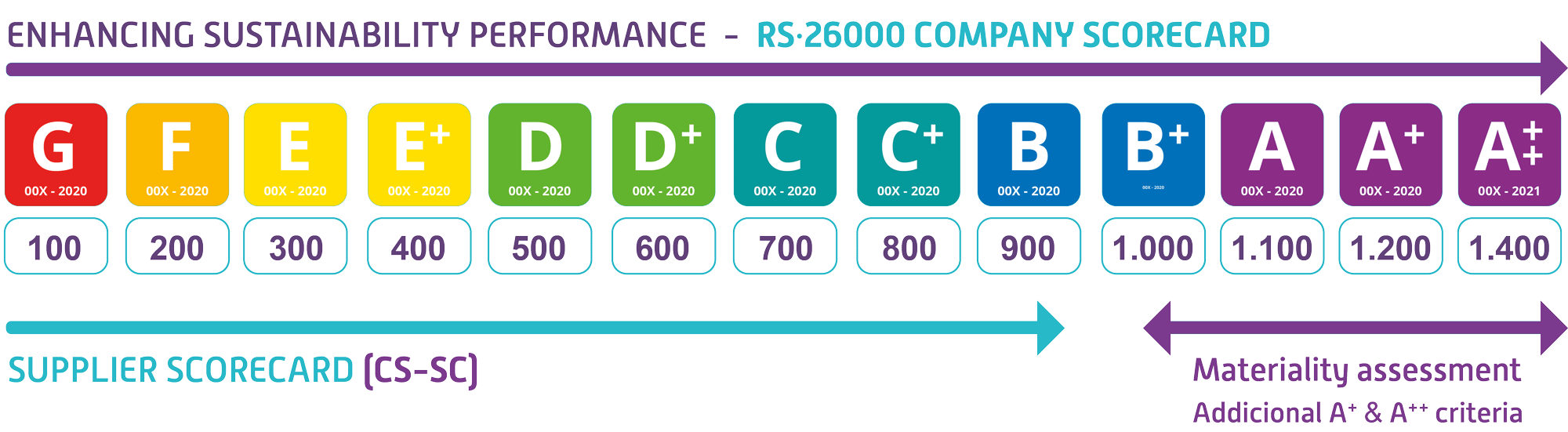
Once you have completed the RightSupply form or questionnaire, the system automatically generates your RS26000 Report or Digital Sustainability Report. This report displays the Provisional Sustainability Index, which ranks performance using a letter-based scale from G to A.
Once the scoreboard total exceeds 1,200 points, you become eligible for RightSupply A+ rating RightSupply additionally requires compliance with and demonstration of the following requirements to the review team that validates the rating.
The A+(PLUS) and A++(PLUS+) added value ratings are awarded when the requirements listed in the 10 sections are met:
1. HAVE A SCORE OF MORE THAN 1,200 POINTS ON THE SCOREBOARD OF THE RightSupply
2. MATRIX / MATERIALITY ANALYSIS (Minimum requirement for categories A and B+)
 Have a materiality matrix o a system for assessing the aspects or impacts relevant to stakeholders (stakeholders and interest groups) in the area of sustainability. The materiality analysis shall also consider the impact of these aspects in relation to the significance for the organisation itself, assessing, where appropriate, the double financial materiality derived.
The organization must Show procedures, plans, or management systems to address the risks, expectations, needs, and opportunities arising from the material aspects identified as key or significant.
3. CLIMATE CHANGE
To have its own renewable energy production facilities at its own sites, whether owned by the organization or under its control through the assignment or acquisition of energy production, such as PPAs (Power Purchase Agreements), that cover 50% of the total energy consumption of production or service facilities ; or, failing that, ensure that 100% of such directly generated (Scope 1) and indirectly generated (Scope 2—emissions associated with non-renewable energy consumption purchased from third parties).
Carbon credits must come from a recognized accreditation program, represent additional, real reductions or removals, be quantified using conservative methodologies, and be verified by an independent third party. They must be individually traceable in a registry, include safeguards against double counting, mechanisms to address the risk of reversal, and environmental and social safeguards. The credits will be irrevocably retired in the name of the organization and for the period covered by the offset.
 In addition and in order to qualify A++ (>1400 points)the organisation shall have calculated its emissions in the three scopes 1,2,3 in accordance with the GHG verified or under ISO 14064-1, and have an emission reduction plan that meets the following criteria:
-
-
- Plan for implementing the Paris Agreement, revised at COP26. It requires a quantitative commitment to reduce and offset total CO2eq emissions, including Scope 3 emissions, by 2030.
- A CARBON NEUTRAL target will be setfor these emissions by the year 2050, although complete decarbonization is recommended, with targets such as the Net-Zero Standard or those aligned with the ISO 14068 standard.
- In the absence of documented public commitments regarding emissions reduction plans , or in the absence of information on targets aligned with the preceding points in the organization’s verified non-financial reports and statements, the organization may use the tool itself RightCarbon tool included in the RightSupply.net rating tool (requires an activation request at validation@rightsupply.net).
-
4. CIRCULAR ECONOMY
This criterion does not apply to service companies where raw materials are not directly incorporated into the product.
Have a life cycle assessment of the product or service (the primary or most representative one), or an eco-design plan that establishes actions or best practices for resource management, reuse, recovery, recycling, reverse logistics, or dematerialization —including raw materials, products, components, and packaging.
Alternatively, the organization must provide a calculation of the Material Circularity Index (MCI). To do so, the organization may use the tool itself RightCircular tool included in the RightSupply.net rating tool (requires an activation request at validation@rightsupply.net). Criterion A+ will be considered met when the value obtained for the local/organizational MSC exceeds 50%.
In addition and in order to qualify A++ (>1400 points), the organization must approve A Roadmap or Master Plan for the Circular Economy with quantitative targets linked to the Material Circularity Index (MCI) of your organization and/or its main products. This plan must cover at least 80% of the weight of the materials involved in the organization’s own processes, as well as the volume of materials involved in the use of its products or the provision of its services. Guidelines such as the Global Circularity Protocol (GCP) for Business, the ISO 59020 standard, or the RightCircular Toolkit may be used. Criterion A++ will be considered met when the value obtained for the local/organizational ICM is greater than 80%.
5. SUPPLY CHAIN. SUPPLIER EVALUATION
To have a system for assessing the sustainability of its suppliers. The evaluation of suppliers shall be annual and shall cover at least the following aspects of the ISO 26000 standard: HUMAN RIGHTS, LABOUR PRACTICES, ENVIRONMENT, FAIR OPERATIONS, CONSUMER/CUSTOMER AFFAIRS, COMMUNITY PROTECTION AND DEVELOPMENT, GOVERNANCE AND TRANSPARENCY.
Unless there is a justified justification, the evaluation shall include a minimum of 50% of the total number of SUPPLIERS or those that represent AT LEAST 50% of the VOLUME of RAW MATERIALS or of SERVICE PROVIDED. The organisation may justify a lower percentage based on the criticality or representativeness of the chosen suppliers or their influence within the organisation.
6. SUPPLY CHAIN. HUMAN RIGHTS
Have at least one effective and enforceable contractual clause applied to suppliers at risk of non-compliance on human rights protection and implement policies and codes of ethics that include human rights due diligence requirements for suppliers.
Provide documentation confirming that the organization adheres to the guiding principles proposed by the United Nations: the Guiding Principles on Business and Human Rights; or, failing that, that it is an active participant in the United Nations Global Compact, demonstrating adherence to its principles.
Demonstrate DUE DILIGENCE as an ongoing, two-way communication process with stakeholders. The company is expected to provide evidence of how it identifies and addresses adverse impacts—whether actual or potential—as well as the action plans it will implement to mitigate these risks of rights violations:
- Right to work.
- No one shall be held in slavery, servitude or forced labour.
- Right to privacy.
- Right to freedom of thought, conscience and religion.
- Right to protection of the family and freedom of marriage, protection of children and adolescents.
- Right to equality before the law, without discrimination.
- The right to just and favourable conditions at work.
- Right to health and safety at work.
- The right to form and join trade unions.
- Right to property.
- Right to social security.
- Right to live in a pollution-free environment.
7. EQUALITY AND NON-DISCRIMINATION: EQUALITY PLAN
To have an Equality Plan that addresses the following elements through analysis, policies and planning for prevention and improvement:
- Equal pay for women and men with a narrowing wage gap (demonstrated by statistics or trend over a period of at least three years).
- Equal opportunities for women to access managerial positions
- Equality in staff recruitment processes
- Communication methods that exclude sexist terminology
- Eradicating the feminisation or masculinisation of jobs
- Prevention of sexual and gender-based harassment
- Reconciliation of work, family and personal life
8. ACCIDENT RATE
Maintain maximum accident rates in accordance with the following parameters:
At the end of the year the accident frequency rate IF = number of lost time accidents x 1,000,000/total hours worked) should be lower than the corresponding sectoral average value.
- Sector Agrícola: < 26,8
- Sector Industrial: < 31,4
- Sector de la Construcció: < 37,3
- Sector de Servicios: < 14,3
9. TRANSPARENCY
Proactively publicise its RS26000 Report and actively make it available to customers and stakeholders, as well as other Corporate Social Responsibility reports, non-financial reports or sustainability reports.
10. JUDICIAL ASPECTS
The organisation shall not dispose of The organisation shall not have unresolved condemnatory legal cases or cases which do not remedy or restore the damaged or infringed asset or right, within the financial year and in matters of:
- Offences against workers' rights
- Unfair competition offences
- Capital flight offences
- Bribery, corruption or money laundering offences
- Ecological crimes, dumping and illegal emissions.
- Misappropriation offences
- Offences against public or private property.
- Offences against the privacy and intimacy of individuals
RESPONSIBLE SELF-DECLARATION (Requirement applicable to all public RS26000 reports and certificates)
Any RS26000 Report or RS26000 Certificate to be published shall include the Responsible Self-Declaration issued on an annual basis by the organisation's top management or by a management body delegated by the organisation's top management. The self-declaration may be replaced by an external audit report provided that it includes a review of the entire contents of the RS26000 Report.
Content verification
The RS26000 Index It is a quantitative assessment of sustainability based on a set of specific indicators of corporate social and environmental responsibility. It uses more than 200 variables as a reference and incorporates the information reported by the organization within the framework of the standard ISO 26000 and the 2030 Agenda. The RightSupply Sustainability Indices and Reports generated in this Platforms must undergo a verification process Content provided by ECOMUNDIS auditors. The organization may be eligible for expanded validation of its RS26000 Index by official certification bodies as part of their own certification processes for norms and standards.
RS26000 Certificate
Once the content has been verified, the organization may publish or disclose its RS26000 Index to its customers and other stakeholders. The RS26000 Certificate is valid for a maximum of one year from the date of issuance, and once it has expired, the platform will continue to make this RS26000Report accessible on this platform for up to three months. RightSupply the right to revoke the RS26000 certificate and to remove from this platform any content declared by the organization if it is demonstrated that the organization has omitted relevant information or provided false information.
The contents, data and information included by the organisations in the RS26000 Report are additionally subject to a Responsible Self-Declaration regarding their accuracy and validity. Independently, this information may be audited or validated as a whole/totality or separately within the framework of the different external auditing processes to which the organisation is subject in compliance with other norms or standardised management and/or eco-labelling norms for its products.
Responsible self-declaration
Any RS26000 Report or RS26000 RS Sustainability Index RS26000 Certificate to be published requires a Responsible Self-Declaration issued annually by the organisation's senior management or a management body delegated by the senior management. The self-declaration may be replaced by an external audit report provided that it includes a review of the entire contents of the RS26000 Report. The self-declaration is found at the end of the RS26000 form and can either be formalised in the same questionnaire or issued in documentary format including the following self-declaration text (document to be attached to the form as a signed and dated pdf file):
- That all the information included in the RS26000 Report for the financial year _______ is true, current and complete to the best of our knowledge and belief.
- That as a member of the Supplier Network RightSupply, our organisation will make the RS26000 report public from today and for the year of its validity.
- That this report is made available to any other interested party or stakeholder for review and contrasted assessment, establishing the e-mail address _____________________ as a means of communication for attention and response to related queries.
For this reason, I sign this document on ___________ First Name Last Name Title
Signature